
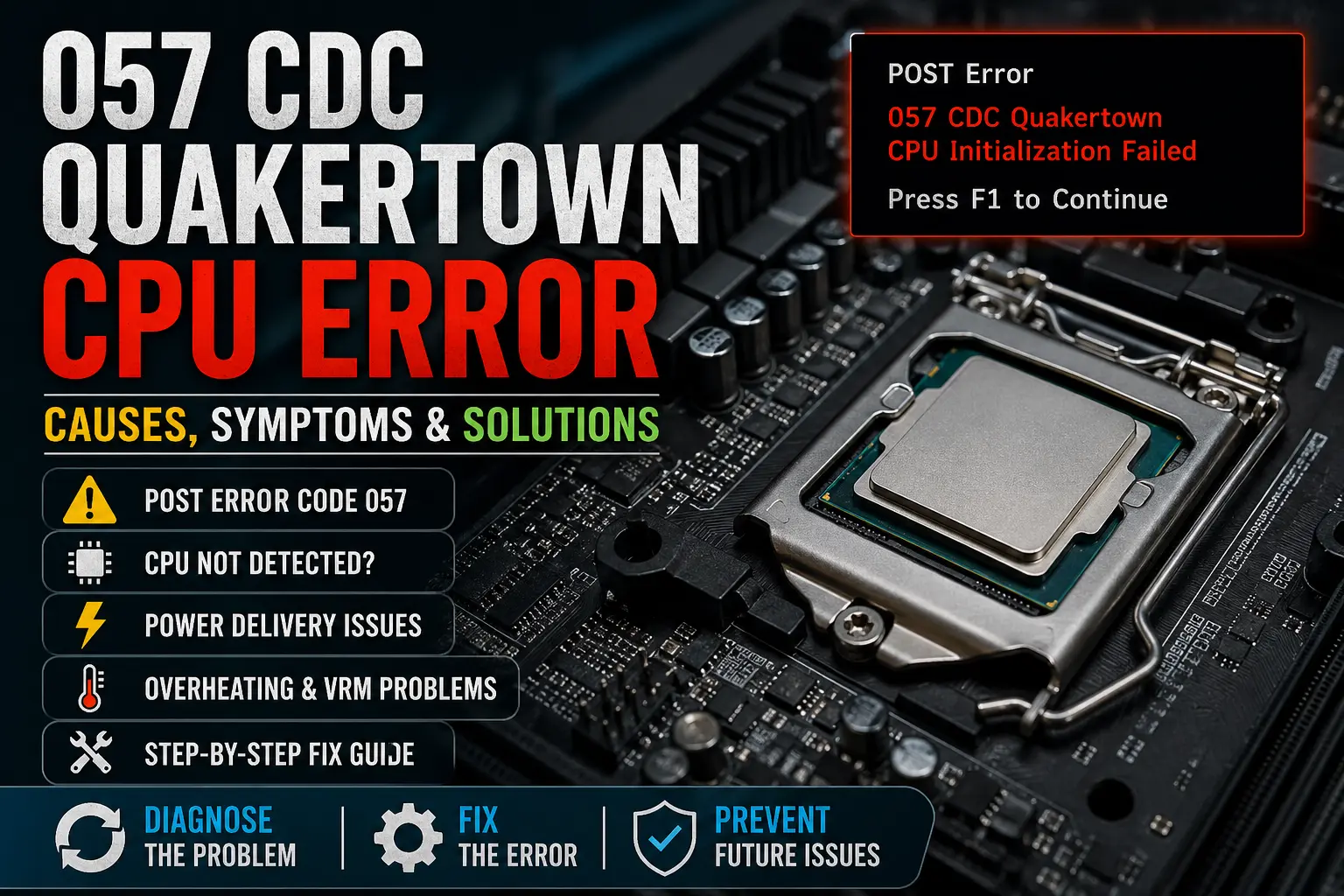
057 CDC Quakertown CPU Error: Causes, Fixes & Technical Troubleshooting Guide
It is one of the most common motherboard CPU error issues and often looks like a dead PC but is actually fixable. If your PC suddenly stops booting and shows the 057 CDC Quakertown CPU error, it can feel like your system is completely dead.
In reality, this issue is often linked to a CPU communication or power delivery problem, and in many cases, it can be fixed without replacing major hardware.
This type of POST error code 057 usually appears when the motherboard cannot properly initialize the processor. In many cases, it is linked to a CPU not detected issue, unstable voltage, or a deeper motherboard CPU error.
The good news? Most of these problems can be diagnosed and fixed with the right approach.
This guide covers the exact CPU error fix methods, from basic resets to advanced hardware troubleshooting.
This guide will help you fix CPU not booting, motherboard CPU error, and power-related startup issues step-by-step.
What is the 057 CDC Quakertown CPU Error?
The 057 CDC error usually points to a communication problem inside your system. In some systems, this means the CPU cannot properly communicate with important components like the power system or motherboard during startup.
In simple terms: your CPU is not getting stable power or proper communication when the PC starts.
In short: your system can see the CPU, but it cannot run it properly. This leads to problems like your PC not turning on, no display, or CPU not detected in BIOS.
Common Symptoms of 057 CPU Error
Users experiencing this issue often report:
– PC stuck on black screen at startup
– System fails during POST
– Fans spin but no display output
– Reboot loop or random shutdowns
– CPU not detected in BIOS
These symptoms clearly point toward a CPU initialization failure or motherboard communication error.
Primary Causes of the Fault
This error might look random, but in most cases, it has a clear hardware or power-related cause. It usually stems from one of the following technical discrepancies:
- Vcore Instability: The VRMs are failing to provide a consistent voltage to the CPU. Learn more about what VRM is on a motherboard and how it affects CPU stability.
- Microcode Mismatch: The BIOS/UEFI version does not support the specific stepping of the installed processor. If you’re unsure about compatibility, check this guide on how to update BIOS without CPU.
- Thermal Throttling at POST: A pump failure in liquid coolers or dried thermal interface material (TIM) causing an immediate temperature spike.
- EPS 12V Fault: A localized short or loose pin in the 8-pin CPU power connector.
- Socket Pin Damage: Bent or oxidized pins in the LGA socket or CPU pads.
In many systems, this type of fault is categorized broadly as a motherboard CPU error, since both components rely on synchronized communication.
Professional Troubleshooting Workflow
These steps are based on real-world PC troubleshooting and commonly fix CPU startup issues.
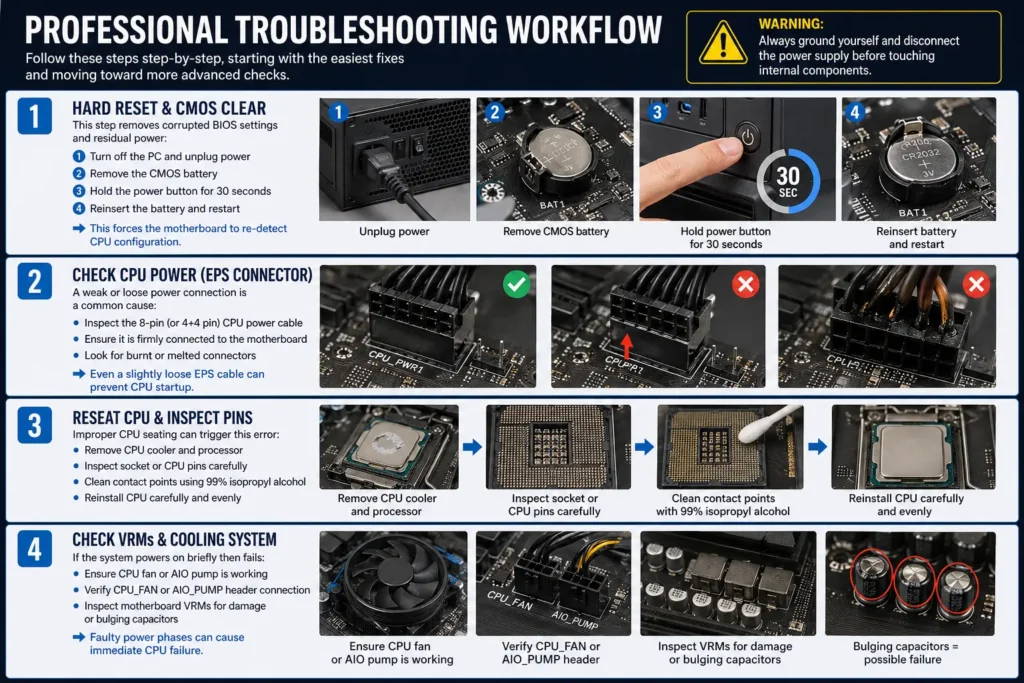
These steps are based on real-world PC troubleshooting and commonly fix CPU startup issues.
Follow these steps carefully, starting from simple fixes. In many cases, the problem gets solved in the first few steps. Warning: Always ground yourself and disconnect the power supply before touching internal components.
1. Hard Reset & CMOS Clear
This step removes corrupted BIOS settings and residual power:
- Turn off the PC and unplug power
- Remove the CMOS battery
- Hold the power button for 30 seconds
- Reinsert the battery and restart
This forces the motherboard to re-detect CPU configuration.
2. Check CPU Power (EPS Connector)
In most real-world cases, this issue is caused by a loose CPU power cable rather than a faulty processor.
A weak or loose power connection is one of the most common causes of CPU power issues in PCs:
- Inspect the 8-pin (or 4+4 pin) CPU power cable. Make sure you’re not confusing cables – read can I use CPU cable for GPU.
- Ensure it is firmly connected to the motherboard
- Look for burnt or melted connectors
Even a slightly loose CPU power cable can stop your PC from turning on completely.
3. Reseat CPU & Inspect Pins
Improper CPU seating is a common reason behind CPU not booting issues:
- Remove CPU cooler and processor
- Inspect socket or CPU pins carefully
- Clean contact points using 99% isopropyl alcohol. If you’re unsure about cleaning, read can I use 70 alcohol to clean CPU.
- Reinstall CPU carefully and evenly
4. Check VRMs & Cooling System
If the system powers on briefly then fails:
- Ensure CPU fan or AIO pump is working. If you are unsure, check how to check what CPU cooler I have.
- Verify CPU_FAN or AIO_PUMP header connection. You can also fix related issues using this guide on how to fix CPU fan speed detection errors.
- Inspect motherboard VRMs for damage or bulging capacitors
Faulty power phases can cause immediate CPU failure.
Troubleshooting Summary Table
| Symptom | Likely Cause | Recommended Fix |
| Error appears instantly on power-on | PSU / CPU power issue | Reseat EPS cable, check PSU |
| Error after 5 – 10 seconds | Overheating / cooling failure | Reapply thermal paste, check cooler |
| Error after BIOS update | Microcode mismatch | Update or roll back BIOS |
| System loops but sometimes boots | VRM instability | Replace motherboard or PSU |
| CPU not detected in BIOS | Socket / CPU issue | Reseat CPU, inspect pins |
When to Seek Professional Hardware Diagnostics
If you have performed a CMOS clear and verified the physical integrity of the CPU/socket but the 057 CDC Quakertown error persists, the issue may be inside the CPU’s internal communication pathways (silicon interconnect), which cannot be fixed manually.
- Test with a “Known-Good” CPU: If a different processor works, the original CPU has experienced an internal failure.
- RMA the Motherboard: If a second CPU fails with the same code, the motherboard’s power phase controller is likely defective.
Prevention & Maintenance
To prevent future CPU communication faults, adhere to these professional maintenance standards:
- Voltage Monitoring: Use software like HWInfo64 to ensure your Vcore levels stay within manufacturer specs.
- Stable Power: Always use a Pure Sine Wave UPS (Uninterruptible Power Supply) to protect sensitive VRMs from line noise.
- Firmware Routine: Update your BIOS only when necessary for compatibility, but ensure you keep “Security Patch” updates current.
Frequently Asked Questions
What causes the 057 CDC Quakertown CPU error?
This error is usually caused by unstable power delivery, BIOS incompatibility, or poor CPU-to-motherboard communication.
Can a faulty PSU cause a CPU error?
Yes. A faulty or unstable power supply can interrupt voltage delivery, which prevents the CPU from starting properly.
Is the 057 CPU error fixable without replacing hardware?
Yes. In many cases, the issue can be resolved by reseating the CPU, clearing CMOS, or checking power connections before replacing any components.
Why is my CPU not detected in BIOS?
This may be due to bent pins, outdated BIOS, or insufficient power from the motherboard.
Should I update BIOS to fix this error?
Only if the issue is related to CPU compatibility. Always check motherboard support before updating.
Conclusion 057 CDC Quakertown CPU
The 057 CDC Quakertown CPU error may look serious, but in most cases, it points to a fixable issue between the processor and motherboard.
Most often, this problem is caused by power delivery, CPU seating, or BIOS compatibility. By following a structured CPU error fix process, you can quickly identify whether the fault lies in the PSU, motherboard, or processor itself.
If the problem still continues after trying all basic fixes, it’s best to test the hardware with professional tools or replacement parts.
Tip: Always double-check power cables and CPU seating before replacing expensive components. Small issues often cause big errors.